
How to Calculate Total Credit Utilization Across Multiple Cards
Learn how to calculate total credit utilization across multiple cards step-by-step. Discover the exact formula, Sarah's case study, and 4 quick tips to boost your score.

You check your credit score, only to be surprised that your new score dropped five points after throwing extra money at the balance. You didn't miss a single payment. Your cards are far from maxed out. What happened?
The issue is most likely your overall credit utilization ratio.
Learning how to calculate total credit utilization across multiple cards will help you understand how your score works and quickly show you how to improve it.
⚡ Quick Takeaways
The 30% Rule: Credit utilization accounts for ~30% of your FICO score and plays a significant part in your VantageScore as well.
Two Numbers: Credit algorithms look at your usage against both per-card vs overall utilization.
The Simple Math: $\text{Total Balances} \div \text{Total Credit Limits} \times 100 = \text{Overall Utilization Rate (\%)}$.
The Sweet Spot: Keeping your ratio under 30% is safest, but high scores (~750+) belong to users who hover between 1% and 9%.
What Is Credit Utilization and Why Should You Care?
Credit utilization is the percentage of your total borrowing capacity that you are currently using. Imagine your credit limit as a gas tank. Credit utilization measures how full that tank is at this particular moment.
Lenders such as Experian, Equifax, and TransUnion update this number on a monthly basis. They receive this information right after your issuing company shares a monthly statement with a current balance. They use it to assess the level of risk they would face by giving you a loan.
When you keep your cards at or near their limit, credit bureaus view you as a high-risk borrower who is dependent on debt to fund a lifestyle. Keeping this percentage low shows lenders that you are responsible and trustworthy.
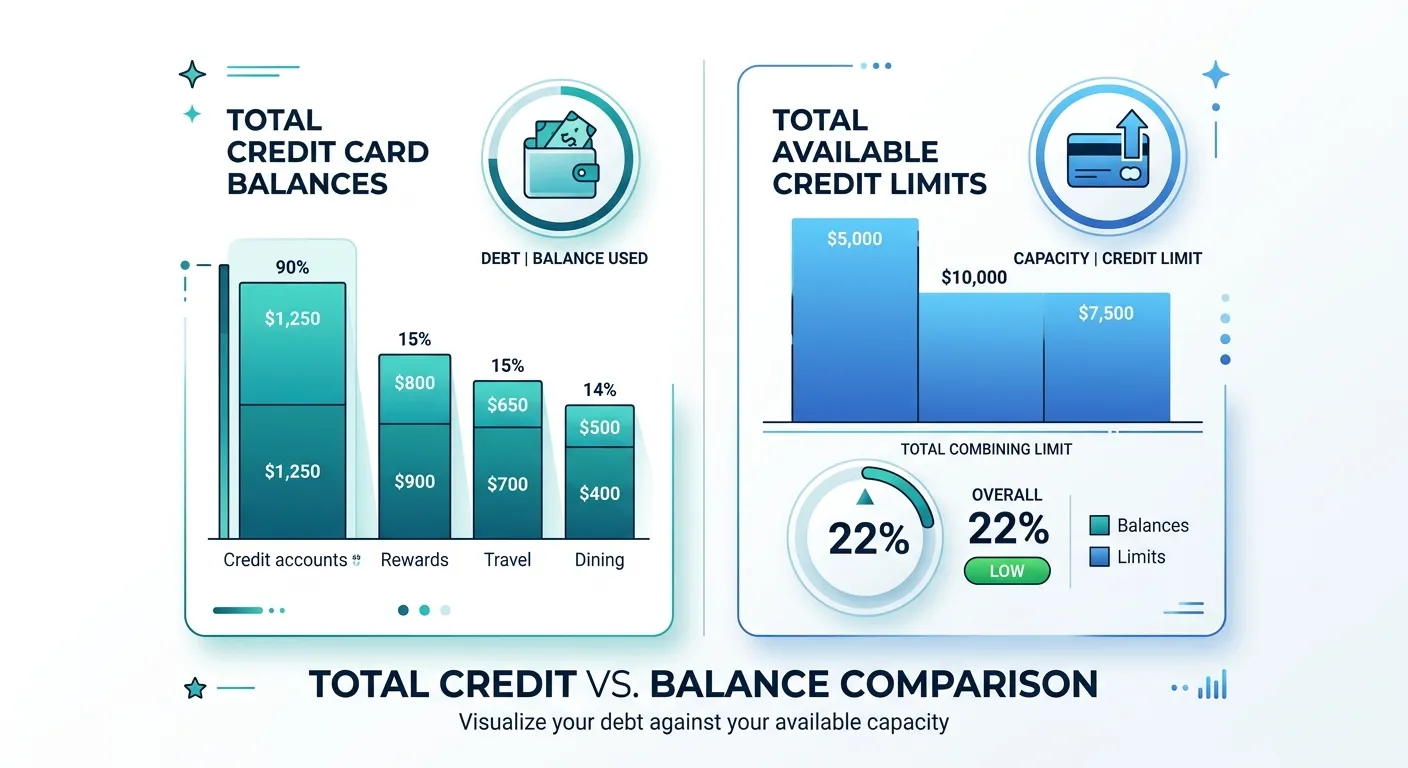
The How to Calculate Credit Card Utilization Formula
⚠️ The Average Percentage Trap
A common error is calculating the percentage used against each card individually, and then averaging those percentages together.
Here is why that creates a problem: a $500 balance on a $500 limit card is 100% utilization. A $500 balance on a $10,000 limit card is only 5% utilization. Averaging 100% and 5% together results in 52.5%. This number is completely misleading for the actual amount of debt you carry.
How to Calculate Total Credit Utilization Across Multiple Cards (3 Steps)
Step 1: Add All Balances Together
Take your latest statements and add all of your card balances together. This number reflects how much total debt you currently carry on your cards.
Step 2: Add All Credit Limits Together
Next, add all of the credit limits for your cards. This is the total amount of money you could borrow across all of your cards.
Step 3: Divide & Multiply
Now divide your total debt balance by your total potential credit limit, and multiply by 100. This gives you your overall credit utilization ratio.
Real Example: Sarah's Cards

Say Sarah wants to apply for a mortgage next year and wants to see how her credit score looks. Here is the info she plugs into the how to calculate credit card utilization formula:
| Credit Card | Current Balance | Credit Limit | Individual Utilization |
| Card A (Rewards) | $1,200 | $5,000 | 24% |
| Card B (Store Card) | $800 | $1,000 | 80% 🚨 |
| Card C (Travel) | $0 | $4,000 | 0% |
| TOTALS | $2,000 | $10,000 | 20% (Overall) |
Using the formula:
- Total Balances: $\$1,200 + \$800 + \$0 = \$2,000$
- Total Credit Limits: $\$5,000 + \$1,000 + \$4,000 = \$10,000$
- Math: $(\$2,000 \div \$10,000) \times 100 = \mathbf{20\% \text{ Overall Credit Utilization Ratio}}$
Sarah's overall utilization is 20%, which is comfortably below the 30% cutoff mark. However, notice that there is a bigger hidden issue at play.
Per-Card vs Overall Utilization: The Hidden Score Trap
While most cardholders only worry about their overall percentage, credit scoring models analyze both per-card vs overall utilization levels.
Card B has an $800 balance on a $1,000 limit, putting it at a whopping 80% utilization. Even though Sarah's overall utilization is only 20%, having a single card sitting at 80% will drag down her score.
💡 Tip: FICO algorithms deduct points if an individual card crosses high thresholds (such as 30%, 50%, or 70%), even if your aggregate card utilization is low. Aim to keep both individual cards and overall usage under 30%.
4 Easy Ways to Lower Your Card Utilization
If your numbers are looking high, don't panic. Credit utilization has no memory in standard FICO scoring models. Once your lender reports lower numbers, your score bounces right back up.
High Balance Reports  ──>  Utilization Spikes  ──>  Score Drops
                                                       │
Pay Down Balances    ──>  Lower Number Reports ──>  Score Bounces Back!
1. Pay Before Your Statement Closes
Credit card companies report your balance on your statement closing date, not your payment due date (which is typically three weeks later). Paying your balance a few days before your statement closes ensures a much lower number gets reported to credit bureaus.
2. Try the 15/3 Payment Schedule
Split your monthly payment into two parts:
- Pay half your balance 15 days before your statement closing date.
- Pay the rest 3 days before the closing date.
3. Ask for a Credit Limit Increase
Call your card issuers or request an increase online. Increasing Card A's limit from $5,000 to $8,000 while keeping the $1,200 balance constant drops your overall credit utilization ratio right away. (Just make sure the lender performs a soft credit check instead of a hard inquiry).
4. Leave Paid-Off Cards Open
When you finish paying off a card, you may want to close it, but hold off. Closing an account decreases your total available credit, which instantly pushes your utilization percentage higher for the remaining balance.
Frequently Asked Questions
Does paying in full every month guarantee a 0% utilization rate?
Not necessarily. If you pay your bill in full on the due date, the balance from your closing date was already reported. To display a 0% balance, pay off the card before the statement closing date.
Is 0% utilization better than 1% for my score?
No, surprisingly. FICO models like to see light and active card usage. Having a reported balance of $0 across every card can give you a slightly lower score than showing a tiny $1 or $2 balance on one card.
Does authorized user utilization count on my report?
Yes. If you are an authorized user on an account with a high balance, that card's usage will factor into your credit score as well.
Will closing an old card raise my utilization?
Yes. Closing an account removes its limit from your total pool of available credit. With less overall credit available, your remaining balances make up a larger percentage of your limit.
Which matters more: per-card or overall utilization?
Overall utilization carries slightly more weight in FICO formulas, but high per-card utilization can still drag your score down. You want to keep both numbers low.
Final Thoughts
Managing your utilization boils down to two numbers: your total percentage and your individual card percentages. Keeping both numbers under 30% (and preferably between 1% and 9%) is one of the best ways to maintain a strong credit profile.
Check your statement closing dates, calculate your current ratios with the how to calculate credit card utilization formula, and make use of these payment techniques to improve your credit score!
Stay happy and wealthy,
Finlly Joy
 Finnly Joy

Disclaimer: The information provided in this article is for educational and informational purposes only and should not be construed as professional financial, investment, or legal advice. Financial situations and credit scoring algorithms vary by individual and location. Always consult with a certified financial advisor or credit professional before making any major financial decisions.