Beyond Amazon: 3 High-Growth Companies Using Nick Sleep’s "Scale Economies Shared" Model Today
Discover how Wise, Shopify, and Costco are weaponizing Nick Sleep's "Scale Economies Shared" framework to crush competitors and compound generational wealth.
The majority of investing advice is to invest in companies that squeeze their customers for your profit and their shareholders' benefit. You are advised to seek pricing power: the ability to go up in price without losing business.
The largest fortunes, after all, are won on doing the opposite, as Nick Sleep of the legendary Nomad Investment Partnership discovered.
From 2001 to 2014, Sleep and his partner Qais Zakaria had a whopping 921% return on their investment. They did not do this by following the trend of hot tech or option trading. They dedicated almost all their capital to only three businesses. The crown jewel was Amazon.
Identifying a rare business engine, Sleep found it and named it Scale Economies Shared.
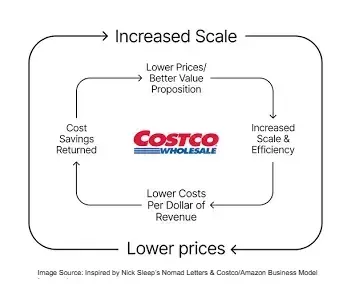
Most businesses grow and reap the benefits of economies of scale. The expenses of their per unit reduce. Typically, executives are left with a decision: either save money and let it pass as an extra profit or pass it on to Wall Street as a dividend.
A "Scale Economies Shared" business opts for a third way. It returns those savings and gives you the money right back—either through lower costs, improved service or some free feature.
This makes for a frightening chain reaction: The connection between the two is that a decrease in prices leads to an increase in customers, which then leads to an increase in volume, which in turn leads to a decrease in costs.
 Finnly Joy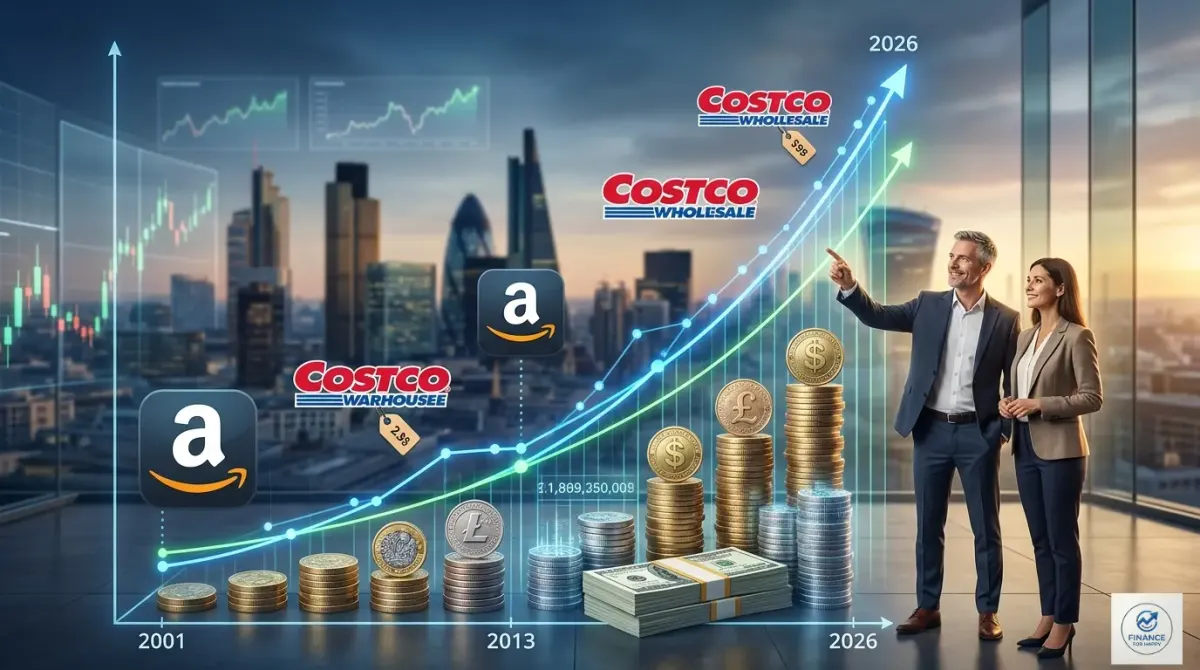
The company's own expansion is its weapon to make its rivals obsolete. It's a good thing that goes round and round, creating an unbreakable relationship between the consumer and the vendor.
Amazon, Costco and Walmart were the initial actors to adopt this model, but a new generation of businesses are quietly reshaping global finance, retail and tech. These are the three modern compounding machines to observe if you want to create generational wealth in your 401(k), IRA or ISA.
1. Wise: Simplifying Foreign Exchange Transactions
Wise is a platform that makes foreign exchange easy. Traditional banks, which were also known as legacy banks, were a legal cartel for decades when it came to money transacting across the borders. Banks charged enormous amounts of money for sending money from New York to London, or Frankfurt to Toronto, in terrible, artificial exchange rates! They squeezed every penny they could out of those who saved their money every day.
With the pure essence of Scale Economies Shared, Wise changed the game, creating a worldwide payment network from scratch.
How the Loop Works at Wise
As more and more expats, freelancers, or small businesses join Wise, the more money that will flow in and out of the system. The higher the volume, the lower the operating expenses per transaction for Wise.
Wise's constitution requires that they cut everyone's fees, rather than keeping that margin to boost their quarterly earnings report.
"We are not in it for the money for your inactivity. We don't want to charge you anything near as much as we could if it were. We want to keep the fees down to as low as possible, even if it's at the expense of our own short term profits."
— Kristo Käärmann, Co-founder of Wise
Why should you put it in your portfolio?
Traditional banks use customer inefficiency and unawareness. Trust and efficiency are the cornerstones of Wise. When there is inflation, every dollar and pound counts and consumers actively seek out the cheapest. Wise is more than just a fintech application, it's a utility that is becoming increasingly difficult to outcompete each and every day.
2. Shopify: Building the Un-Amazon Infrastructure
Amazon has a big problem, as it bundles up every customer into one app, it makes the third party merchants, who sell on its platform, nothing but statistics. Amazon will often produce a generic version of a product if the original product is popular and then price it lower.
Shopify did it the other way around. They agreed to supply the rebels with weapons. They developed the platforms for anyone to conduct an independent e-commerce business, e.g. the digital storefronts, payment gateways, the inventory systems.
 Finnly Joy
What is the Loop and how does it work?
Shopify is able to leverage the bargaining power that it has because of the fact that hundreds of thousands of small businesses have started using the platform. This is how they are able to get the rock-bottom rates from the shipping companies (such as UPS and FedEx) and credit card processors.
Shopify then passes these much lower prices directly on to the mom and pop store owners that use its platform. The one-person small business in Manchester and Ohio has a sudden access to the same logistical cost savings as a Fortune 500 company.
Shared Scale Comparison
| Feature | Legacy Retail Competitors | Shopify’s Shared Scale Model |
|---|---|---|
| Pricing Strategy | Increase price with brand value increasing | Decrease merchant costs with platform scale increasing |
| Merchant Relationship | Extract data; compete with best sellers | Provide infrastructure; succeed only when merchant succeeds |
| Moat Stability | Vulnerable to changing consumer preferences | High switching costs; ecosystem lock-in |
The significance of it for the portfolio
Shopify's economies of scale foster high customer loyalty. When it comes to shipping, it's not just the software that changes for a small business when they leave Shopify, it's the fees they have to pay instantly. That's a growth moat on a foundation of common prosperity.
3. Costco (The Timeless Standard)
Talking about Nick Sleep's model without bringing back up Costco would not make sense. It is not a tech company of the internet age, but it is the cleanest example of Scale Economies Shared on Earth and a good protection for a retail investor's portfolio.
Costco has a strict policy, almost a religious one, that anything cannot be sold for more than 14% – 15%. In comparison, the average supermarket will mark up items by 25-30% and the department store may add up to 50%.
The Loop Works at Costco
When Costco purchases toilet paper, television sets, or organic coffee in large quantities, the price of the individual units drops significantly. The Wall Street Whale is continually yelling at Costco to charge a bit more just to make a more profit. Costco refuses. They pass through the register at the warehouse to the consumer directly.
Almost all of their income comes from membership fees that are paid once a year. You have to pay a membership fee to enter the building, and as part of this you feel like you have something to lose if you don't purchase everything in the building to get your value for money.
 Finnly Joy
How it affects your portfolio
Consumers never stop buying food and household goods during a recession, economic downturn or high inflation. They are looking for ways to make ends meet. Costco's dedication to sharing its scale makes it a safe haven for the economy. It's a brick and mortar company with a digital competitiveness.
How to find Stocks that share Scale Economies?
If you're looking for the next Amazon or Nick Sleep type multi-bagger via your brokerage account (Vanguard, Fidelity, Charles Schwab or Hargreaves Lansdown), you need to look past the typical financial screens. These companies are not always the cheapest in terms of price/earnings ratios. One must understand management's psychology.
To read the Annual Shareholder Letters
Search for founders with a passion for “customer satisfaction” and “growing volumes in the long term” instead of “short term operating margins.” If a CEO all but extorts his or her customer base in a letter for higher prices, leave. They are devouring their own seed corn.
Capital History Allocations should be checked
Are they buying into price cutting, user experience, or building a technological moat? Or are they spending billions on financial engineering, such as repurchasing overpriced stock simply to maintain the share price that is necessary to incentivize the executives?
Your Actionable Retail Investor Checklist
When deciding whether or not to commit your hard-earned savings or adjust retirement account contributions, follow the Nick Sleep checklist:
- [ ] The Pricing Test: Are there any opportunities to reduce the end-user cost of the product/service as the company expands?
- [ ] The Moat Test: Does a competitor have an instant disadvantage in being a competitor to this company because they don't have the volume and scale?
- [ ] The Leadership Test: Has it got a visionary founder, or a long-term oriented CEO who is not a short-term mercenary manager concerned with the next quarter?
- [ ] The Customer Stickiness Test: Would Customers wait 24 hours for a company's website or app to come back online or would they immediately move on to a competitor? (Yes / No / Maybe)
The Bottom Line
In the eyes of Wall Street, complexity is a virtue. It's liked by algorithms, high-frequency trading, and black box financial products. However, the retail investors' history has taught that the most simple concepts are the most innovative.
Nick Sleep's philosophy means that you are forced to ask yourself one simple question: Does this company make its customers' life in the long run more expensive, more difficult or more costlier?
If the answer is no, and they are sharing the financial fruits of their scale, don't worry about the daily noise of the stock market. Buy the shares, maximize your tax-advantaged accounts, and let the unstoppable engine of shared scale compound your wealth for the next decade.
Stay happy and wealthy,
Finally Joy
Founder, Finance For Happy
Before we look at how these three modern giants are scaling today, it's crucial to understand how this framework was born. If you haven't read it yet, check out our foundational breakdown: [The Nick Sleep Nomad Strategy: How a 921% Return Rewrote the Investing Rules]. You’ll learn exactly how Sleep spotted early-stage Amazon using this exact same playbook.
Disclaimer: This article is for informational and educational purposes only and should not be construed as professional financial or investment advice. Always conduct your own research or consult with a certified financial advisor before making major financial decisions.