
Beyond Baby Step 3: How to Build a Warren Buffett Stock Portfolio Without Going Broke
Ready to move beyond Dave Ramsey's Baby Step 3? Learn how to build a safe, Warren Buffett-style stock portfolio and grow wealth without going broke.
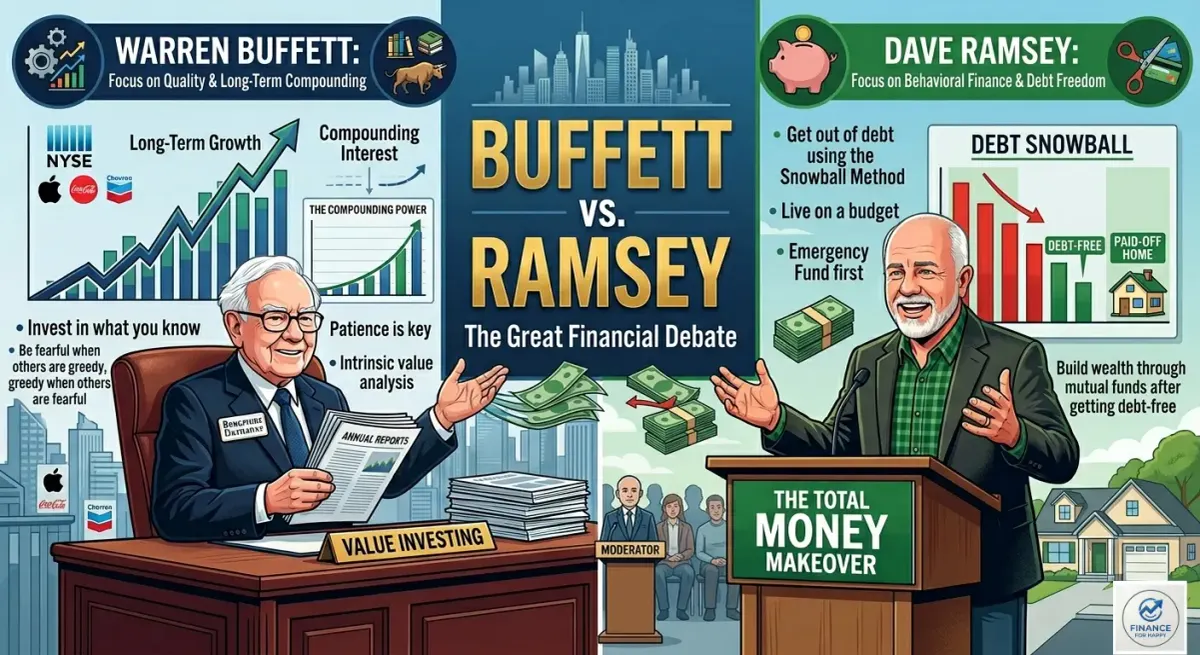
Why is the conventional “personal financial advice” so overtly designed to keep you safe in the middle class? You listen to the radio and obey the instructions, you cut out the coupons and you nod your head in agreement, but financial freedom seems like a carrot that's just out of reach. The truth is the playbook you're using is not complete.
Step into the greatest financial paradox. Dave Ramsey, the undisputed king of getting people out of debt, built his empire on a specific defense. However, his investment strategy of pushing people toward actively managed mutual funds—while intended to capture market growth—routinely funnels everyday investors into high-fee structures and front-end loads that drag down long-term performance. Conversely, Berkshire Hathaway's Warren Buffett is the reigning champ of building capital through a concentrated value investing philosophy. The problem, however, is that you can't comfortably play Buffett's high-conviction offense when you're underwater and looking over your shoulder.
A hybrid approach is where the breakthrough lies. You're able to free up cash flow by employing Ramsey's ruthless defense system. After securing the perimeter, you can quickly switch to Buffett's offense playbook. This is the way to overcome scarcity and begin creating exponential wealth.
1. Building the Armor: The Ramsey Defense
It is impossible to think straight when you're preoccupied with next month's mortgage payment or an upcoming credit card bill. Debt puts you in a defensive and short-term frame of mind. But it takes radical long-term thinking to build wealth. If you're going to play offense like Warren Buffett, you must first establish a rock-solid financial fortress using a strict defense.
The key to your defense is to be hyper-focused on the first three financial milestones:
- Clear the Runway: Pay off all consumer debt except your mortgage with a focused repayment strategy (the debt snowball)—moving from the smallest to the largest balance. This includes credit cards, car loans, and student loans.
- Establish Your Shield: Lock away a liquid reserve representing 3 to 6 months of absolute living expenses.
- Save in High-Yield Accounts: Keep this money protected from inflation without using a traditional brick-and-mortar bank account. Park it in a modern High-Yield Savings Account (HYSA) which is 100% liquid and accessible at any moment.
The game changes the day you've paid off your last consumer debt and put money into your emergency fund. You just unlocked the most powerful tool to make money: Your paycheck.
2. Changing to Offense: The Buffett Value Strategy
So, you've got your financial edge protected now it is time to "play to win" rather than "play not to lose". While Warren Buffett publicly advocates for broad low-cost S&P 500 index funds for the average retail investor, his private formula for generating elite wealth relies on an active, ultra-focused value strategy. If you choose to step out of passive index tracking to pick individual stocks, you must treat your portfolio not like a trading screen, but like a corporate acquisition.
Once you have made the switch to direct stock investing, it's essential that you follow Buffett's fundamental rules:
Avoid purchasing tickers, invest in real businesses
The stock market is not a lottery, nor is it just a line flashing on a smartphone app. You are buying a business with a life! Do not be a minority owner of a company if you're not prepared to buy the whole company. Seek out companies that are selling products or providing services that you really know something about and that you believe will still be in existence in 10 years.
Find the economic moat
A great business is a castle and every great castle needs a moat in order to protect itself from rivals. Search for companies that have sustainable, unshakable competitive advantages. This can be built upon enormous brand equity, whereby the company can raise prices as much as they want, or an enormous cost structure advantage—known as Scale Economies Shared—whereby the firm becomes so large it passes the savings on to the consumer, effectively preventing competition.
Fear Over Greed ("Buy the Dip")
The overall stock market is an emotional beast that can be unpredictable. Mass panic leads to a downward correction in stock prices during geopolitical crises, market corrections, or short-term corporate issues. As the mobs flee in terror, you can get up close and do just the opposite, simply because you have a Ramsey-backed emergency fund to keep you stable. Market crashes are a once-in-a-lifetime buying opportunity, allowing you to acquire premium corporate assets at a bargain price.
You can use your extra money to invest in real, growing, profitable businesses with pricing power, instead of holding cash that's eroding in value.
3. The Direct Comparison: Mutual Funds vs. Direct Stock Selection
In order to appreciate the effect of the hybrid route on wealth accumulation, it is important to examine what goes on in a typical mutual fund. If you invest in actively managed funds, you pay a group of Wall Street pros to select stocks for you.
The catch? They cost you money for this service every single year—without regard to whether they make a profit or lose one. A seemingly insignificant 1.5% fee can empty hundreds of thousands of dollars from your ultimate retirement savings over a 20 or 30-year period of time.
Also, many mutual funds have what is known as "closet indexing"—they acquire a load of a variety of stocks to look good in regards to the market as a whole, but they actually perform nothing better than the market itself, minus their high fees. With direct stock selection, you can skip the middleman altogether.
| Feature | Dave Ramsey's Mutual Fund Path | Warren Buffett's Direct Stock Path |
|---|---|---|
| Expense Ratios (Management Fees) | High (Often 1% to 2% for active funds) | Zero (When buying directly through modern brokers) |
| Control Over Allocation | None (It's up to the fund manager) | Complete (You buy what you know) |
| Tax Exposure | High (Capital gains distributions may be taxed) | Low (You determine when you sell and recognize capital gains) |
| Risk Profile | Average risk with diversified stagnation | Focused risk with large upside potential |
4. Implementing in Practice: Modern Accounts (US vs. UK Framework)
It doesn't require a private Swiss bank account or a high-end wealth manager to make this happen. The stock market can be accessed by everyone, even retail investors, thanks to modern financial technology, and they can invest by simply clicking a button. The legal bucket, however, has a great significance because of the tax implications that come with shareholding.
United States Investors
For those who are domestic U.S. citizens, the primary battleground is avoiding Uncle Sam's capital gains taxes. After you have funded your emergency savings, consider a Self-Directed IRA or a Roth IRA with a low-cost brokerage like Fidelity, Charles Schwab, or Vanguard.
By investing in a Roth IRA, you can have your post-tax money grow 100 percent tax-free, so that all of your dividends and stock appreciation from Buffett-style investments can be yours to keep in the future.
Most modern brokerages will now allow you to invest in fractional shares, so if a single share of the big dog in the room, say Costco or Apple, costs hundreds of dollars, it's possible to start with just a $10 investment.
United Kingdom Investors
When you're working the UK financial market, the best tool at your disposal is the Stocks & Shares ISA (Individual Savings Account). If you use a platform such as Trading 212, Interactive Brokers, or Hargreaves Lansdown, you can protect up to £20,000 per year from Capital Gains Tax and Dividend Tax.
A Stocks and Shares ISA provides a totally tax-free environment where your investments can compound cleanly.
The same can be done in the UK with modern platforms that offer the ability to invest automatically on a recurring basis, meaning that you can program your account to invest in a fraction of your selected businesses as soon as your paycheck arrives.
5.Power of Long-Term Compounding

The secret that both financial masters and ordinary mortals share is an unwavering devotion to the mathematics of exponents. Human brains are linear thinkers; we need growth to be consistent and static. Compounding, however, works silently year after year, and then explodes up and up.
Take the reality of Warren Buffett's wealth into consideration. He bought his first stock as a child, but more than 90% of his entire net worth was generated after his 65th birthday. It is not a magical trick that he discovered, but rather something that he did—he allowed his profitable investments to grow without interruption over the course of many years.
The task of the investor who buys an individual stock with an unshakeable economic moat is not to monitor its daily price action. Regularly checking your portfolio can cause emotional noise, which can result in panic selling. The principle of real wealth is to do nothing, and let time do the heavy lifting.
6. Your Next Steps
It's not a one-off lucky shot that makes a million-dollar portfolio; it's a consistent, disciplined approach that does it. The Ramsey plan's hard-and-fast rules do the financial cleanup, and the Buffett approach of analytical patience drives the financial growth.
Here's your easy-to-follow list for moving beyond survival to becoming aggressive at building wealth:
- [ ] Audit Your Debt: Make a list of all of your consumer debts from smallest to largest, and tackle them using the debt snowball.
- [ ] Save for a Rainy Day: Aim to save 3 to 6 months' worth of expenses in a High-Yield Savings Account (HYSA).
- [ ] Open a Self-Directed Account: Register with a low-cost brokerage to establish a tax-advantaged investment account (Roth IRA in the U.S. or a Stocks & Shares ISA in the U.K.).
- [ ] Find 3 Core Businesses: Research and list three well-known businesses that you are very familiar with that have clear economic moats.
- [ ] Automate Your Allocations: Establish a monthly allocation from your paycheck directly to your individual stocks, treating it as a non-negotiable monthly commitment.
- [ ] Commit to the Long Haul: Make a decision not to sell your shares during the next market correction—instead, see the drop in prices as an “extra discount” sale!
Building a portfolio is only half the battle; the real magic happens when you let compounding work over time. To understand how this works in reality, read our guide on [the power of consistency in investing]
Disclaimer: This article is for informational and educational purposes only and should not be construed as professional financial or investment advice. Always conduct your own research or consult with a certified financial advisor before making major financial decisions.