The Silent Path to Exponential Wealth: The Power of Consistency in Investing
Forget 'get-rich-quick' schemes. The real path to wealth is boring, disciplined, and surprisingly silent. Learn how the power of consistency and the math of compound interest can turn small monthly savings into a multi-million dollar legacy in the US and UK. Stop guessing; start building.

In a world where everyone is obsessed with get-rich-quick schemes, the loudest voices are usually those screaming about the newest crypto run-up or a high-stakes stock gambit. However, a closer examination of the most successful investors in the world—Warren Buffett, Nick Sleep, and others—reveals that the key is not genius or luck. It is a disciplined, nearly tedious adherence to consistency.
Investors in the UK and the USA cannot outsmart the market to build wealth in 2026. It is about outlasting it. In this guide, we shall explore in detail why consistency is the only "free lunch" in finance and how you can use it to transform small monthly savings into a multi-million-dollar legacy.
1. The Psychology of the Consistent Mindset
The failures of most investors are not due to bad math, but to bad psychology. The human brain is programmed to respond to instant gratification. We desire rewards today. Investing, however, is a game of delayed gratification.
Consistency is the bridge between an aim and its attainment. It is the discipline to continue purchasing your S&P 500 index fund when newspapers announce a "Market Crash Incoming." The decision fatigue that causes emotional selling is eliminated by automating your investments. A business model (and an investment plan) is valuable only when it works at scale and over time—a point Nick Sleep frequently emphasized.
 Finnly Joy
2. Compound Interest: The Eighth Wonder in Motion
Compound interest is said to be the eighth wonder of the world, according to Albert Einstein. "He who understands it, earns it; he who doesn't, pays it."
Compounding is where your investments start producing their own returns. At first, the development is very gradual—like watching grass grow. However, after 15 or 20 years, the "hockey stick effect" comes into play, and your wealth starts to increase exponentially.
The Mathematical Consistency of the Early Years
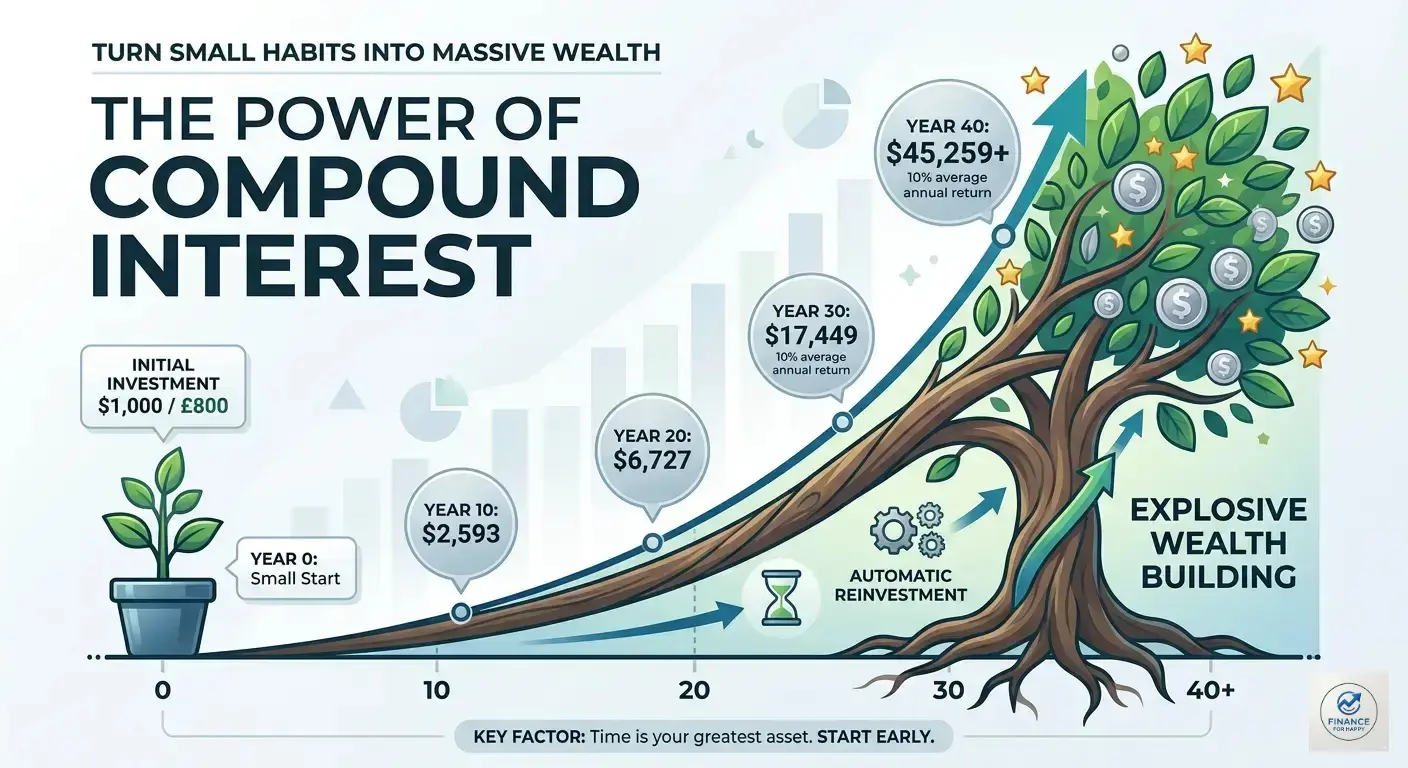
We will examine a couple of hypothetical investors, Investor A (The Early Starter) and Investor B (The Procrastinator), using average US/UK market returns of 10% per year (around 7% when adjusted for inflation).
- Investor A: Begins at age 22, invests $500 (£400) every month for 10 years, and does not invest another penny after that.
- Investor B: Waits until age 32, then invests $500 (£400) every single month over the next 30 years until retirement at age 62.
The Result at Age 62:
Although Investor B invested three times as much money over a much longer duration, Investor A will still have a significantly larger portfolio. Why? Because consistency in those early years provided the compounding engine with a decade-long lead.
3. Facts on the Ground: The Boring Strategy Works
Let’s look at the historical performance of the S&P 500. The average annualized performance over the past 30 years (1994–2024) was about 9% to 10%.
Had you put in $1,000 (£800) each month starting in 1996—through the Dot-com bubble, the 2008 financial crisis, and the 2020 pandemic—you would now have a portfolio worth over $2.1 million (£1.7M).
It wasn't a matter of picking the right year to buy, but rather always picking a year not to sell. This is referred to as Dollar-Cost Averaging (DCA). When you spend an equal amount each month, you automatically purchase more stock when prices are low and less when prices are high.
4. Your Wealth Blueprint (US vs. UK)
The math is the same, but the "buckets" you keep your wealth in vary according to where you live. When it is tax-efficient, consistency is even more powerful.
For US Investors:
- 401(k) / 403(b): The simplest method of automating consistency. The amount is deducted from your paycheck before you see it. Always contribute enough to receive your full employer match—it is a 100% immediate payoff.
- Roth IRA: An effective instrument where your regular deposits grow tax-free. A top priority for long-term wealth should be maximizing your Roth IRA in 2026.
For UK Investors:
- ISA (Individual Savings Account): You are allowed to invest a total of £20,000 per year. Capital gains and dividends are tax-exempt. The Stocks and Shares ISA is the gold standard for the consistent UK investor.
- SIPP (Self-Invested Personal Pension): Just like the US 401(k), the government gives you a tax relief bonus on your contributions, giving your money an automatic kick-start.
5. Comparison: Consistency vs. Intensity
Many individuals attempt to "sprint" when it comes to investing. They save half their earnings for three months, then burn it all on a holiday. This is Intensity. Investing is a Marathon.
| Factor | Intensity (The Amateur) | Consistency (The Professional) |
| Deposit Style | Large, irregular lump sums | Small, regular monthly sums |
| Market Timing | Tries to "buy the dip" | Buys every month, no matter what |
| Stress Level | High (checking charts constantly) | Low (set and forgotten) |
| 20-Year Result | Usually underperforms the market | Traditionally accumulates colossal wealth |
6. Automating Your Financial Success
If you have to think about investing every month, you will eventually find an excuse not to do it. The car needs a repair, or you want a new phone. To be a successful investor, you must take the human factor out of the loop.
- Pay Yourself First: Set the transfer to occur on the same day your salary is deposited.
- Select Low-Cost Index Funds: Steer clear of managed funds with high fees. Use total market trackers (such as Vanguard or BlackRock). Fees are the kryptonite to wealth.
- Increase Your "Drip" Every Year: When you receive a raise, increase your monthly investment by even 1%. This "micro-consistency" results in enormous changes over ten years.
 Finnly Joy
7. The Philosophy of Sitting Still
Nick Sleep often said that the most difficult thing in investing is doing nothing. In a 24/7 news cycle and TikTok "stock guru" world, sitting still feels like losing.
However, statistics show the most active traders nearly always lose to the individual who just purchases an index fund and takes a walk. Consistency is not only about the money you inject, but also about the time you leave it in. Each time you sell and buy something new, you reset your compounding clock.
Summary: Start Small, Start Today
Everyone can harness the power of consistency. You don't need $100,000 to start. You just need $100 and a commitment.
Whether you are in the UK or the US, the road to financial freedom is filled with dull, repetitive, monthly steps. Stop searching for the "perfect" stock. Begin to develop the ideal habit. The noise of today's market will not matter to your future self 20 years down the line. They will only care that you stayed the course.
Stay happy and wealthy,
Finnly Joy.
What if your Side Hustle was as predictable as your Index Fund?
Most people fail at side hustles because they treat them like a sprint. But the 1% treat them like an investment. See how the Power of Consistency transforms a 'hobby' into a reliable income stream.
Disclaimer: This article is for educational and motivational purposes only. I am not a financial advisor. Credit cards involve financial risk; please conduct your own research or consult a professional before making major financial moves.