Earning More But Saving Less? The Psychology Behind Lifestyle Creep
Earning more but saving less? Discover why lifestyle creep happens, how hedonic adaptation ruins your finances, and 3 practical ways to stop lifestyle inflation.

When we receive our monthly income / salary, often we think:
If I can just earn a bit more, I’ll start saving!
So we look forward to our next pay rise or promotion.
However, what happens?
A few months down the line, we’re right back at square one again, hoping for another high income.
Upon experiencing this, I decided to take a step back and finally realized what was happening. Not just to me, but so many people fall into this trap. We all like to show off and impress others around us. However, it is quietly taking away from your future wealth.
Instead of saving/investing, we upgrade our lifestyle. We upgrade our house, our car and plan to enjoy our new luxuries. We spend all spare money.
We’ve fallen victim to lifestyle creep.
Lifestyle creep is when you start to spend more money on small luxuries without realizing. This is an invisible tax on your freedom from your own success. Without knowing why lifestyle creep occurs, your hard work will result in you on a shiny treadmill.
Why More Money Doesn’t Seem Like More Money
When discussing money, we often go on about numbers. High interest savings accounts, low expense index funds and tax benefits such as your 401(k)/IRA in the US or Stocks and Shares ISA in the UK.
However, our wealth is 80% behavioral and only 20% numerical.
As soon as you earn more money, your idea of a normal amount of money increases. What was once a luxury becomes a necessity.
Upgrading your coffee to a latte/espresso instead of a basic drip coffee as you feel you deserve it.
Upgrading multiple subscriptions to premium, extra cloud storage and fitness apps. It doesn’t matter as it’s only $10.
Moving to a new house with a balcony, in unit washing machine/tumble dryer and home office.
Whilst this may not seem like a lot of money individually, overall you’ll never be able to spend more than what you’re earning.
You’re not becoming wealthier, you’re showing everyone you’re living a higher standard.
 Finnly Joy
Hedonic Adaptation
Psychologists call this hedonic adaptation. Humans are amazing at adapting to their environment and returning to a neutral emotion.
Once you’ve upgraded your car, phone or location, you’ll feel a surge of dopamine. However, this will only last 2 weeks and you’ll quickly adapt to your new luxurious lifestyle.
You won’t be any happier, but you’ll be more costly to maintain.
Worse still, you’ve created a hidden weakness in the macroeconomy. If there is an economic downturn or your industry is suddenly cutting jobs, you’ll be in a panic as you’re spending a large portion of your monthly income. You’ve given up your financial security for short term comfort.
Social Influence

We don’t live in a vacuum. Often, when your income increases, so does your social circle.
You start hanging out with people who have a higher income or give more with their money. Suddenly you’re eating at new restaurants, going on more exotic holidays and upgrading your clothes to match the higher standard of the room.
This is the modern version of keeping up with the Joneses. However, most of the time the Joneses are completely broke. They’re using high interest credit cards and long term car loans to fund their lifestyle.
If you’re copying your financial habits to those around you, you’re likely copying people who’s as stressed about their money as you are, they’re just dressed better.
 Finnly Joy

How To Break The Cycle (Without Becoming A Monk)
Whilst being cheap won’t help in the long run, cutting your spending too much will cause you to get burnt out and blow your savings on a huge shopping spree.
Be mindful with your spending!
Spend as much as you want on things that make you happy. However, be ruthless with cutting out anything that doesn’t provide genuine value.
Below are a couple of ways to ensure you keep your raise and get to financial independence quicker:
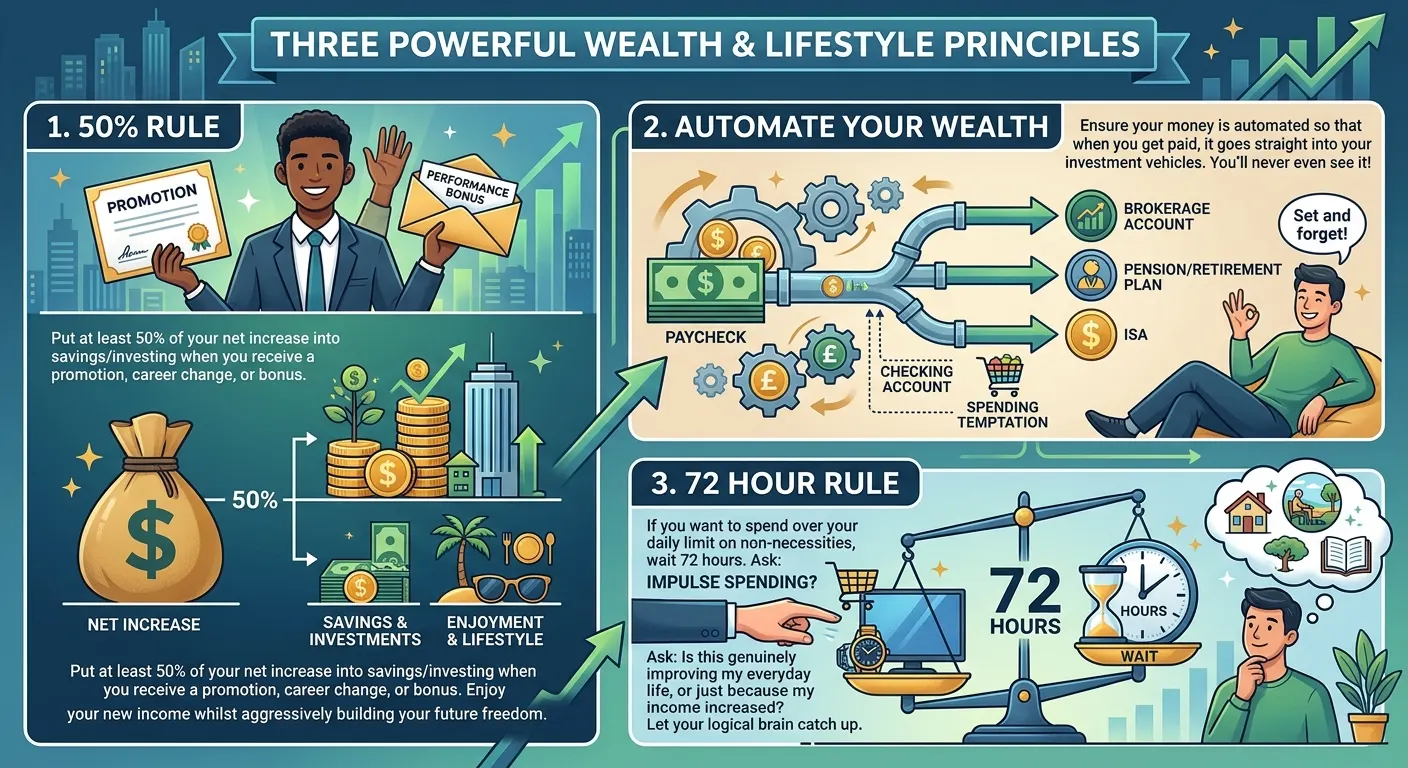
- 50% Rule -> Put at least 50% of your net increase into savings/investing when you receive a promotion, career change or performance bonus. This way you can enjoy your new income whilst aggressively building your future freedom.
- Automate Your Wealth -> We have limited amounts of willpower. If you have spare money in your checking account you will find a way to spend it! Ensure you have your money automated so that when you get paid, it goes straight into your brokerage account/pension/retirement plan/ISA. You’ll never even see it!
- 72 Hour Rule -> If you want to spend over your daily limit on something which isn’t necessary, wait 72 hours. Ask yourself if you’re genuinely improving your everyday life or if it’s just because your income has increased. This allows your logical brain to catch up.
Checklist
Ensure you’re not losing out on wealth by:
[ ] Increasing your automatic investments to match your last 2 raises.
[ ] Fixed monthly costs (rent, subscriptions, car payments) are under 50% of your take home pay.
[ ] You can cancel your latest upgrades with little effect on your happiness.
[ ] You’re tracking your savings rate (How much you’re saving of your income).
Look at your last 3 bank statements and identify where you’re quietly losing money due to lifestyle creep. Choose one regular cost to reduce or automate. Put this amount towards your future.
Stay happy and wealthy,
Finlly Joy
It starts with small upgrades—a nicer car, extra dinners out, premium subscriptions—until your new salary vanishes. Uncover the hidden psychological triggers behind lifestyle inflation.
Disclaimer: The information provided in this article is for educational and informational purposes only and should not be construed as professional financial, investment, or legal advice. Financial situations and credit scoring algorithms vary by individual and location. Always consult with a certified financial advisor or credit professional before making any major financial decisions.