The Invisible Money Pit: How 'Lifestyle Creep' is Silently Robbing Your Future Wealth
Earning more but saving less? Discover how lifestyle creep quietly drains your pay raises, why outgoings rise with pay, and how to protect your future wealth.

You have received a pay increase.
Your bank balance has gone up.
But somehow, your financial freedom feels like it is more out of reach than ever. If every time you get a pay increase your outgoings rise proportionally, then you’re getting sucked into this sneaky trap. A lot of people work their way up the corporate/business world, earning more and more each year. Yet when they reach their mid-life, they have high incomes, high stress and critically low emergency savings. How does this happen? It isn’t due to bad luck or poor macroeconomic factors. It happens due to a sneaky psychological trap.
 Finnly Joy

The Trap Of Success
We often see earning more money as our ultimate answer to financial stress. We tell ourselves:
"If I just earned a bit more, I would start saving!
Once I get this promotion, I’ll never have any money issues again!"
Then we get our pay increase and...
A few months later we’re right back where we started, waiting for our next pay increase.
When I experienced this, I took a step back and analyzed what was going on. It’s not just me that gets caught in this trap. Every day savers, retirement planners and millions of everyday people fall into this trap.
We want to keep up with everyone else.
We purchase unnecessary items with money we don’t have just to impress people we don’t even like! Our natural human desire causes us to fall into lifestyle creep and slowly lose our future wealth.
How It Sneakily Steals Your Future Wealth
Making small lifestyle tweaks may seem harmless but it all adds up. This creates a sneaky trap that will steal your future wealth. Here’s how.
The True Cost Of An Extra $800
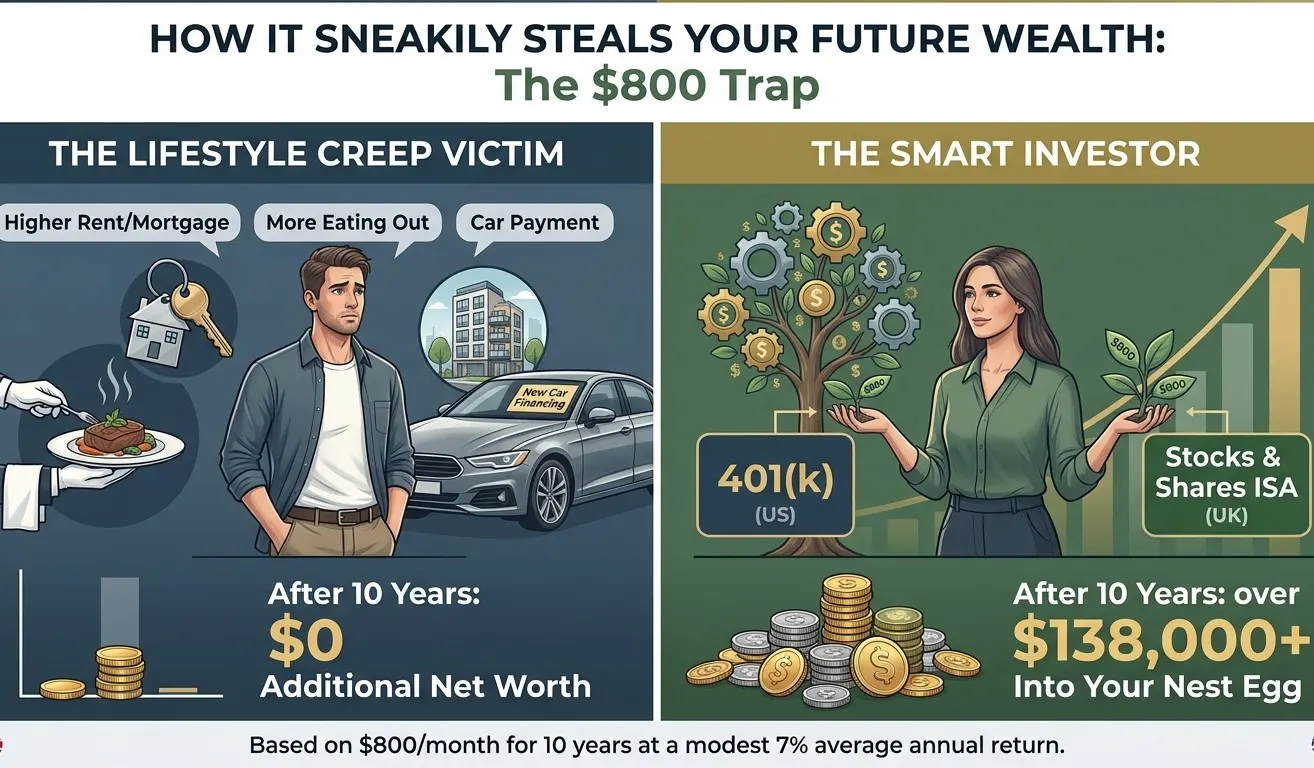
If your salary increases to $70,000 to $84,000 (+$800 in net monthly income after taxes).
- The Lifestyle Creep Victim: Uses that extra money to upgrade to a more expensive apartment, eat out more often, and take on a new car financing payment. At the end of 10 years, their additional net worth is $0.
- Smart Investor: They don’t change their lifestyle and invest their exact $800 every single month into a Stocks and Shares ISA or a 401(k). With a modest 7% average annual return, that amount grows into a massive $138,000+ into their nest egg over the next 10 years. Lifestyle Creep has stolen $138,000 of your future wealth.
The Fixed Cost Trap
While everyday items such as food and clothes can be reduced at any time, lifestyle creep causes your fixed costs to rise. Rent, car leasing and monthly commitments can’t easily be reduced if you hit a sudden issue at work or during an economic downturn. This causes you to lose your financial freedom and peace of mind.
Irreversible Opportunity Cost
Every tiny lifestyle improvement will push your financial independence further into the future. You’re sacrificing your future security and stress free independence for a temporary boost.
Who Wins?
Assume both individuals received an extra $800 in net monthly income. (The investor earns a 7% average annual return).
| Timeframe | 👤 The Lifestyle Creep Victim | 📈 The Smart Investor |
| After 3 Years | • Pays installments on a new car. • Buys new living room furniture. • Extra Wealth Accumulated: $0 | • Emergency Fund Fully Built • Investment Account Has Gained Momentum • Extra Wealth Accumulated ~$32,000 |
| After 5 Years | • Monthly fixed expenses are heavily inflated. • Fear of job loss and anxiety run high. • Extra Wealth Accumulated: $0 | • Compound Interest Magic • Financial Independence Has Been Built • Extra Wealth Accumulated ~$57,000 |
| After 10 Years | • Back at square one despite 10 years of hard work. • High stress and low security. • Extra Wealth Accumulated: $0 | • Full Financial Freedom & Peace Of Mind • Passive Income Created • Extra Wealth Accumulated ~$138,000+ |
"At the end of 10 years, the lifestyle creep victim is left with depreciated luxury items and high monthly bills. Meanwhile, the investor has built a $138,000+ financial cushion."
 Finnly Joy

The Hedonic Treadmill
This is known in psychology as hedonic adaptation. Humans have an amazing ability to adapt to our environments. When we introduce something new and exciting into our lives we feel a temporary high.
When we upgrade our phone, car or area we live in we get an instant hit of dopamine. However, this will quickly fade within weeks.
You will return to your usual emotional baseline. However, your monthly costs have now increased. What used to be a luxury to do twice a week or go on exotic holidays now feels like a necessity.
As well as this, you’ve created a weak household economy. If there is a sudden lay-off in your industry or during a macro-economic downturn you’ll instantly panic as your monthly fixed costs are so high. You won’t be able to easily reduce your rent or car payments.
You’ve sacrificed your long term security and true freedom for short term comfort.
The Social Trap

We don’t live in isolation. Often, when your income increases so will your social circle.
You’ll start hanging out with people that earn more or are more spendthrift. You’ll start eating at expensive restaurants, going on luxury holidays and upgrading your wardrobe.
This is the modern version of keeping up with the Joneses.
However, a lot of these Joneses are broke! They’re using high interest cards, personal loans and long term car leases to fund their luxurious lifestyle.
If you copy their habits, you’re likely copying people that are just as stressed about their money, but look better dressed.
Four years ago I was given a pay rise and had the option to spend the extra money (plus using a bit of a loan) to upgrade my vehicle to give myself that 'success’ image. People were commenting why didn’t I upgrade my car to match my new salary.
I decided to take out a little loan and invest in some land with a small house on it.
Fast forward to now and the loan is fully paid off. The property is providing me with an income every month from renting it out. By resisting the temptation to upgrade my vehicle and delaying my gratification I am now able to upgrade my vehicle if I wanted to as I would have no debt to take on.
Real financial freedom is not about driving the latest car but having assets that are paying for your life whilst you sleep.
 Finnly Joy

How To Avoid The Trap (Without Becoming A Monk)
You don’t need to become a monk to avoid this trap. If you cut your spending too much you’ll cause yourself to have a huge money burn out and eventually spend your savings on a huge shopping spree.
The key is to be mindful with your spending. Spend as much as you want on things that make you happy but be strict with cutting out anything that provides no real value.
What To Do Next
Before your next pay increase/bonus, set up some defences:
- The 50% Rule – Whenever you receive a pay increase or bonus, put at least 50% of your net increase into savings/investments. Enjoy the remaining 50% without guilt.
- Automate Your Wealth – Humans have limited will power. If you have extra money in your current account you’ll find a way to spend it. Automatically transfer money into your investment accounts when you get paid.
- The 72-Hour Rule – If you feel the urge to spend on something unnecessary beyond your usual spending, wait 72 hours. Ask yourself if it genuinely makes you happier in your everyday life.
Checklist
Make sure you’re not losing your wealth:
- [ ] Have I increased my automated contributions to my retirement/investment account (401k, IRA or ISA) to match my last 2 raises?
- [ ] Are my fixed monthly costs (rent, subscriptions, car debt) below 50% of my take-home pay?
- [ ] Can I cancel my recent lifestyle improvements with little impact on my happiness?
- [ ] Am I tracking my savings rate?
Look at your last 3 bank statements today. Identify where you’re losing money due to lifestyle creep with no real return and cancel these. Put this money towards your future freedom.
Stay happy and wealthy,
Finlly Joy
EARNING MORE BUT SAVING LESS? THE UNSEEN TRAP KEEPING HIGH EARNERS BROKE
Disclaimer: The information provided in this article is for educational and informational purposes only and should not be construed as professional financial, investment, or legal advice. Financial situations and credit scoring algorithms vary by individual and location. Always consult with a certified financial advisor or credit professional before making any major financial decisions.