
What Is Credit Utilization Ratio and Why Should You Care?
If you pay your balance in full every month, a sudden drop in your credit score can be confusing. The culprit is often your Credit Utilization Ratio—how much limit you use when your statement closes. Master the timing of your payments to protect your score and unlock financial growth.
What Is Credit Utilization Ratio and Why Should You Care?
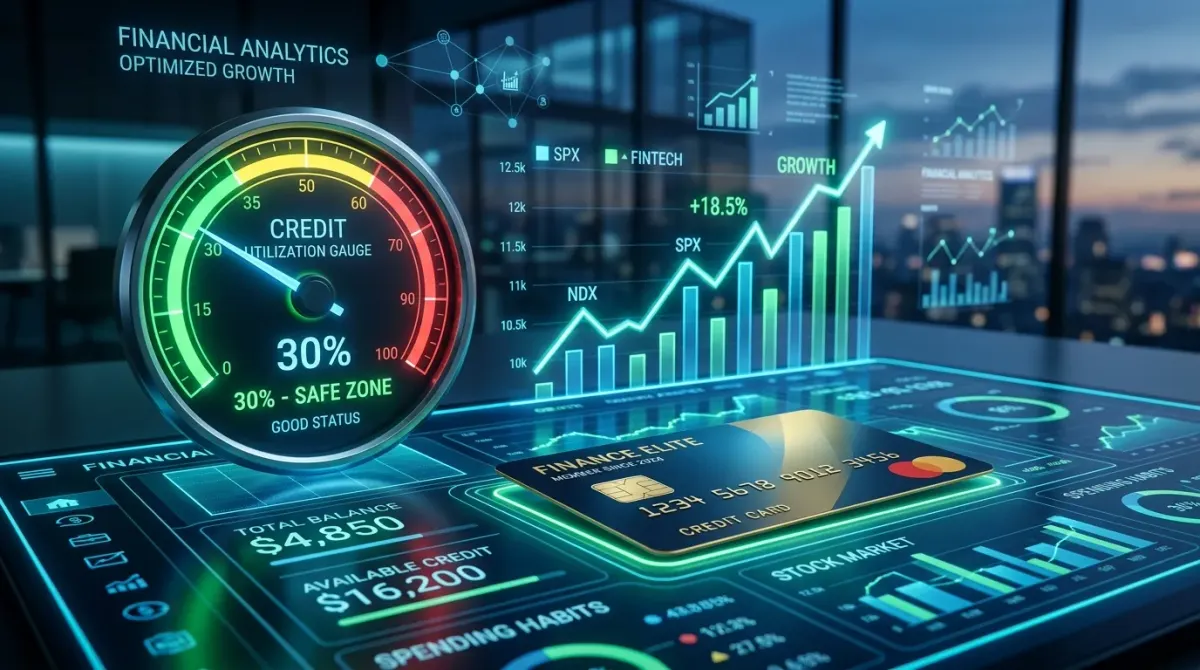
Credit utilization ratio is basically an indicator showing how much of all the credit limits you currently utilize. This is a percentage found by dividing current credit balance by the credit limit, then multiplying the result by one hundred.
Suppose you have only one credit card with the limit of $2,000 and current credit balance of $600. Then:
$$\text{Credit Utilization Ratio} = \left( \frac{$600}{$2,000} \right) \times 100 = 30%$$
The formula above is considered an excellent predictor of your financial stability from the point of view of the FICO score and VantageScore algorithms. In fact, credit utilization takes 30 percent of your FICO score, making it the second most important factor, after the payment history.
 Finnly Joy
FICO Score Breakdown:
- Payment History: 35%
- Credit Utilization: 30% ◄── You affect it every day when you swipe a credit card!
- Length of Credit History: 15%
- New Credit & Applications: 10%
- Credit Mix: 10%
The 30 Percent Credit Utilization Rule Unveiled
The financial experts always advise to stay below 30 percent credit utilization rule. When your balances exceed this level, algorithms of credit scoring take your profile as a risky one.
Nonetheless, the 30% rate is a passing score. But if your aim is to attain a credit score of more than 750, a utilization rate of one digit, which lies between 1% and 9%, would produce excellent results.
| Utilization Level | Impact on Credit Score | Lender Perception |
|---|---|---|
| 0% | Slightly Sub-optimal | Inactive credit usage |
| 1% – 9% | Optimal Score Boost | Highly responsible borrower |
| 10% – 29% | Moderate / Neutral | Acceptable risk level |
| 30% – 49% | Moderate Score Drop | Elevated financial dependency |
| 50%+ | Severe Score Drop | High default risk |
How Daily Credit Card Usage Increases Utilization Rate

As you move all of your household expenses to your credit card, the amounts spent each time appear insignificant. Your morning coffee costs you $5, $120 for your groceries, and a $15 landing page subscription.
When you have $1,500 as your total credit card limit and you spend an average of $40 each day, your credit card balance will be $1,200 after 30 days.
In such case, your utilization will be at 80%. Whether or not you have your entire money of $1,200 safely parked in your bank account to settle your bills next week, your credit score systems will note that you have used 80% of your card limit already.
The Difference Between Statement Closing Date vs Due Date
To comprehend how your daily usage of credit cards impacts credit score calculations, it is necessary to know the differences between statement closing date vs due date.
- Statement Closing Date: Last day of every month used to close your account. Your card issuer also generates your monthly statement and sends your current balance to credit bureaus (Equifax, Experian and TransUnion) on this same day.
- Payment Due Date: The date you should pay your bill to avoid late fees and interest charges (21-25 days after your statement closing date).
Since credit bureaus report your balance on the statement closing date, paying your bill on time is close to three weeks late to help mitigate the high balance reported.
Real-World Case Study: Maya vs. Sam
Let's look at two friends, Maya and Sam, to see this action in the real world. They both are able to pay off their debts with the same $3,000 credit limit, and they spend $1,500 per month on their regular day-to-day costs. They pay off their balance before their bill is due and never pay interest on a cent.
Maya's Approach (Traditional Payment)
- Maya has swiped her card every day this month.
- Her balance on her Statement Closing Date is $1,500.
- The credit bureaus report a credit utilization ratio of 50% on her report.
- Outcome: Maya's credit score falls 18 points even though she has always paid her bills on time.
Sam's Approach (Strategic Timing)
- Sam uses his card every day for the same types of costs.
- Every Friday Sam logs in to his banking app and pays into his account $1,200 during the month.
- His ‘Statement Closing Date' is only $300 left.
- He uses 10% of his credit card limit.
- Outcome: Sam's credit score improves by 12 points and he moves to the excellent credit range.
A step-by-step guide to help you protect your scores
No need to break up your card or cancel benefits to keep a good credit rating. You only have to change your balance update approach.
- Execute the Micro-Payments Strategy: Use the micro-payments approach to paying your balance back in smaller chunks over time, like weekly or bi-weekly. Signing on on payday or on a weekly basis (usually Friday) to pay off your balance means you don't have much debt rolling over from week to week.
- Pay your payments just prior to your statement due date: Look at the statement closing date that is listed on the online dashboard or PDF statement. Place a recurring phone reminder to pay off 90% of your balance — 3 days before this date.
- Apply for a credit line increase without being asked: Contact your credit card company or make a credit card company credit limit increase online request. Even if you have a consistent income, and your payment history is good, a higher limit from $2,000 to $6,000 will automatically lower your credit utilization ratio by half with all the same spending habits.
$$\text{Initial Scenario:} \ \frac{$1,000 \text{ Spend}}{$2,000 \text{ Limit}} = 50% \text{ Utilization}$$
$$\text{Higher Limit Scenario:} \ \frac{$1,000 \text{ Spend}}{$6,000 \text{ Limit}} = 16.6% \text{ Utilization}$$
- Pay Off Debts with Other Cards: If you have two or three credit cards, switch the cards you use every day for your purchases, rather than using just one. Credit scoring models look at the utilization of all your cards and also look at the utilization on each individual card.
 Finnly Joy
Frequently Asked Questions (FAQ)
Does it help my credit score to pay off my credit card as soon as I make a purchase?
If you pay for all purchases as they come in, then your utilization is 0%. This will keep your score from dipping, but having a small amount of credit, between 1% and 9%, listed on your statement closing date will be a little better with regards to lenders demonstrating you are active and responsible with your credit.
Will regular spending on credit cards lead to permanent credit card credit utilization problems?
No credit utilization doesn't “have any memory” in conventional credit scores such as FICO 8. Having a credit score recalculate and bounce back within 30 days of your credit card issuer reporting a lower balance on your next statement closing date is normal.
Which is better, credit or debit cards?
Unlike debit cards, credit cards provide a better level of fraud protection, cash-back rewards and credit-building opportunities. If you're disciplined with how you use your balance, daily credit card usage is much safer and more beneficial than daily debit card usage.
Become a Credit Steward!
The key to sustaining daily credit card spending and keeping the credit utilization in check is to time it right, and not to spend less money. You will be able to enjoy the perks of swiping cards every day and still create a solid credit foundation for future wealth, if you make your payments on time and maintain low balances reported to the credit bureaus, and do this based on your statement closing date.
Stay happy and wealthy,
Finlly Joy
 Finnly Joy
Disclaimer: The information provided in this article is for educational and informational purposes only and should not be construed as professional financial, investment, or legal advice. Financial situations and credit scoring algorithms vary by individual and location. Always consult with a certified financial advisor or credit professional before making any major financial decisions.