How to Qualify for Public Service Loan Forgiveness (PSLF) in 2026
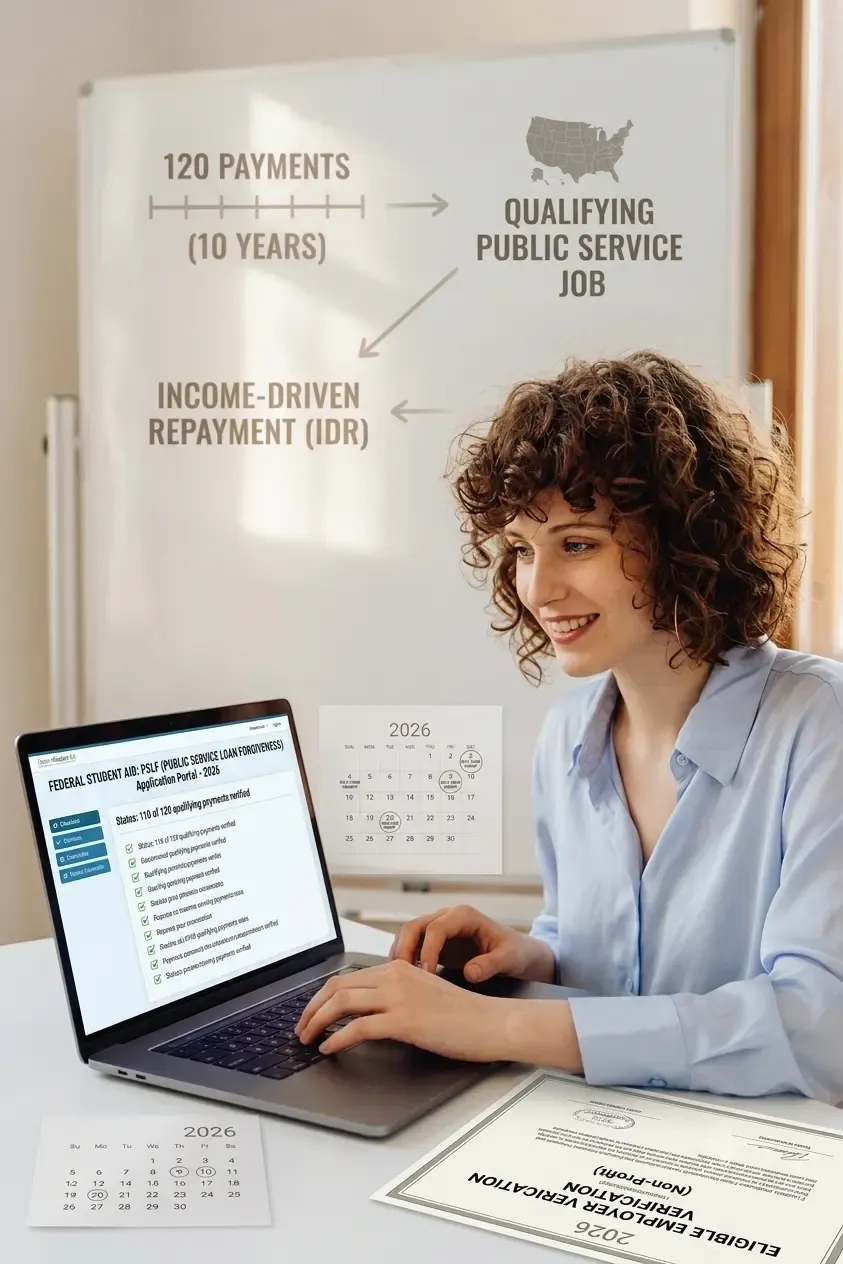
Qualify for PSLF in 2026 by working full-time for a government or 501(c)(3) nonprofit, holding Direct Loans, and making 120 payments under an Income-Driven Repayment plan. With SAVE vacated, borrowers must use IBR or the new RAP system to earn forgiveness credit.
If you are one of the many Americans working as a teacher, nurse, government employee, or non-profit worker, you probably carry a heavy burden of federal student loans. Luckily, there is a completely legal way to eliminate your remaining balance tax-free: the Public Service Loan Forgiveness (PSLF) program.
However, navigating the strict guidelines set by the Department of Education can feel incredibly overwhelming. One minor error on your paperwork can instantly derail years of hard work.
If you are unsure about how to qualify for public service loan forgiveness 2026, this all-in-one, no-nonsense guide will break down the exact steps, requirements, and latest updates to help you achieve financial freedom this year.
Why is the PSLF Program a Game-Changer?
The Public Service Loan Forgiveness (PSLF) program is a federal initiative that forgives the remaining balance on your Direct Loans. To qualify, you must make 120 qualifying monthly payments under an approved repayment plan while working full-time for an eligible public service employer.
The best part? Unlike traditional loan forgiveness options which the IRS treats as taxable income, the debt canceled through PSLF is 100% tax-free at the federal level.
The 4 Golden Requirements to Qualify in 2026
To successfully secure loan forgiveness, your employment and loan structure must meet all four criteria established by the federal government. Let's look at each requirement in plain English.
1. The Right Employer (Public Service Only)
Eligibility for PSLF is strictly based on who employs you, not your specific job title. To qualify, you must work full-time (at least 30 hours per week) for:
- Any U.S. federal, state, local, or tribal government organization.
- A non-profit organization that is tax-exempt under Section 501(c)(3) of the Internal Revenue Code.
💡 Critical Note for Private Workers: If you are a nurse working for a private, for-profit hospital, or a teacher at a private, for-profit school, your employment does not qualify for PSLF, even if you are providing a public service.
2. The Right Loan Type (Direct Loans Only)
Only federal Direct Loans are eligible for the PSLF program.
- Eligible: Direct Subsidized, Direct Unsubsidized, Direct PLUS Loans, and Direct Consolidation Loans.
- Ineligible: Federal Family Education Loans (FFEL) and Perkins Loans.
What if your loans don't qualify? You must consolidate them into a federal Direct Consolidation Loan via StudentAid.gov. Once consolidated, those older balances become eligible to start earning qualifying monthly credits.
3. The Right Repayment Plan (IDR)
You cannot make your 120 payments on a standard or graduated repayment plan. You must be enrolled in an Income-Driven Repayment (IDR) plan. These plans cap your monthly student loan payments based on your actual income and family size to keep them affordable.
Eligible IDR plans include:
- Saving on a Valuable Education (SAVE) plan
- Income-Based Repayment (IBR) plan
- Pay As You Earn (PAYE) plan
4. The 120 Qualifying Payments
You must accumulate 120 separate monthly payments.
- These do not have to be consecutive. If you leave a non-profit job for a corporate role and later switch back to a public service position, your payment count simply pauses and resumes exactly where you left off.
- Payments only count if they were made after October 1, 2007, and while you were actively employed full-time by an eligible employer.
How to Apply and Track Your PSLF Status: Step-by-Step
Because PSLF paperwork is too important to get wrong, you must follow a precise process to ensure the government tracks your payments properly.
- Step 1: Verify Your Employer's EligibilityLog into your StudentAid.gov account and launch the official PSLF Help Tool. Enter your employer's Federal Employer Identification Number (EIN)—which is easily found on your W-2 form—to instantly verify if your workplace qualifies.
- Step 2: Consolidate Ineligible Loans ImmediatelyIf you currently hold older FFEL or Perkins loans, submit a Direct Consolidation Loan application on StudentAid.gov as soon as possible. This transfers your debt into the Direct Loan program so future payments actually count toward forgiveness.
- Step 3: Sign Up for the RAP or an Approved IDR PlanApply for the new Repayment Assistance Plan (RAP) or a qualifying Income-Driven Repayment plan. To maximize the total amount forgiven at the end of your 10-year journey, select the qualifying plan that offers the lowest calculated monthly payment.
- Step 4: Submit the PSLF Certification Form Every Single YearDo not wait a decade to let the government know you are in public service. Complete and submit the PSLF Employment Certification Form (ECF) annually, and whenever you change employers. This officially updates your qualifying payment tracker.
Critical Updates for 2026
Student loan regulations undergo frequent shifts. In 2026, the Department of Education continues to process data adjustments related to past payment count recalls, giving many borrowers retroactive credits.
Additionally, the management of all PSLF forms has completely shifted away from individual private loan servicers (like MOHELA) and is now handled directly by Federal Student Aid (FSA) through StudentAid.gov. This centralization makes tracking your 120 payments significantly easier, unifies your financial dashboard, and minimizes processing errors.
Summary: The Final Takeaway
Getting your public service loans forgiven is a marathon, not a sprint. By aligning your employment with a 501(c)(3) non-profit or government entity, ensuring your debt consists of federal Direct Loans, staying active on an IDR plan, and submitting your certification forms annually, you will legally and permanently eliminate your student debt.
Stay happy and wealthy,
Finally Joy
Founder, Finance For Happy
With the old SAVE plan gone and the new RAP system taking over in 2026, how will your loan payments and forgiveness timelines completely change? To break it down simply, read: [The New 2026 Student Loan Laws: Your No-BS Guide to Navigating the RAP System]
(Disclaimer: The information provided in this article is for educational purposes only and should not be taken as professional financial or legal advice. Please consult Federal Student Aid or a certified financial planner for your specific situation.)