
How to Lower Credit Card Utilization Rate Without Paying Money (5 Free Hacks)
Discover how to lower your credit card utilization rate without paying money. Use these 5 simple banking hacks to drop your ratio, boost your FICO score, and keep your cash!

Think about checking your credit score and seeing it randomly drop by 30 points. You have yet to default on your payments and you even have a lower credit card debt balance than previously. What in the world?!?
Most likely the reason for your drop in score was due to an increase in your credit card utilization percentage! Having your credit utilization ratio in excess of 30% is seen by lenders and credit bureaus as high-risk behavior even if you are not missing out on any of your monthly payments.
Great news - you don't need an additional couple of thousands to fix this! You can actually figure out how to lower your credit card utilization rate without paying money by employing a few smart bank tricks!
Here is your free blueprint to speed up the process of your ratio reduction, boost your score, and save your hard-earned cash:
📌 Quick Summary: Key TakeawaysRequest a credit limit increase: INSTANTLY reduces your percentage without paying a dime.Time your payments: Pay right before your statement closing date, not your due date.Keep old cards open: Retains your total available limit.Spread out balances: Distributes what you spend on various cards instead of maxing out a single one.Become an authorized user: Lets you ride on the back-end of another's high-limit, excellent payment history card.
 Finnly Joy

What Is Credit Utilization and Why Does It Matter?
Your credit utilization rate is just the math of what you have versus what you owe.
If you have a $1,000 credit limit and a balance of $500, then your utilization rate will be 50%. Even though many financial gurus will say anything below 30% is acceptable, the key to achieving an excellent score is keeping your percentage under 10%.
Why do lenders, credit bureaus, and your credit score care so much about utilization? Approximately 30% of your overall FICO score depends on it! This number shows lenders how reliant you are on borrowed money to fund your lifestyle.
1. Request a Credit Limit Increase
By far the quickest way to reduce your percentage without spending any more than you need to on your cards in the short or long-run is to make the bottom number in your math equation exponentially higher.
If you have $1,000 on a card with a $2,000 limit sitting at 50% utilization, when your credit card company increases it to $5,000 while your balance stays at $1,000, your utilization automatically goes down to 20%.
Here's how:
- Log in or dial the customer service number on the back of your card.
- Look for something along the lines of "Request Credit Limit Increase."
- State your income correctly. If you made an extra paycheck last month or have a side hustle, state so!
- Important: Ask whether the request will require a "hard pull" versus a "soft pull" on your credit report. Always go with a soft pull!
 Finnly Joy

2. Shift Your Payment Timing (Try the Statement Date Trick)
Everyone waits until their statement due date to make payments on their credit cards, but by then, most credit card companies have already reported your high balance to the credit bureaus.
Your issuer will report to the major credit bureaus (e.g., Experian, Equifax, TransUnion) on your statement closing date, which is usually 21 to 25 days prior to your actual payment due date.
Real World Example:
Say you're Sarah, who has a card with a $3,000 limit. During the month, she charges $1,200 for normal household expenses that she regularly pays off in full every month on her due date with money in her checking account.
Since her balance is reported on her closing date, her card issuer sends that $1,200 balance report to credit bureaus every month. To lenders, Sarah appears to have a reputation of constantly using 40% of her credit line!
The Fix: All Sarah has to do to shift her percentage is log into her account 2 days in advance of her closing date and pay off her balance. After the billing statement generates, the reported balance will be $0, and Sarah can keep her cash while boosting her credit score at the same time!
3. Keep Unused Credit Cards Open
One of the first things most people do when they finally pay off a credit card is close it, but doing this can be very detrimental to your score!
Doing so gets rid of that card's credit limit in your total available credit pool.
Suppose you have two cards:
- Card A: $500 balance with a $2,500 limit.
- Card B: $0 balance with a $2,500 limit.
- Total Utilization: $\frac{\$500}{\$5,000} = 10\%$
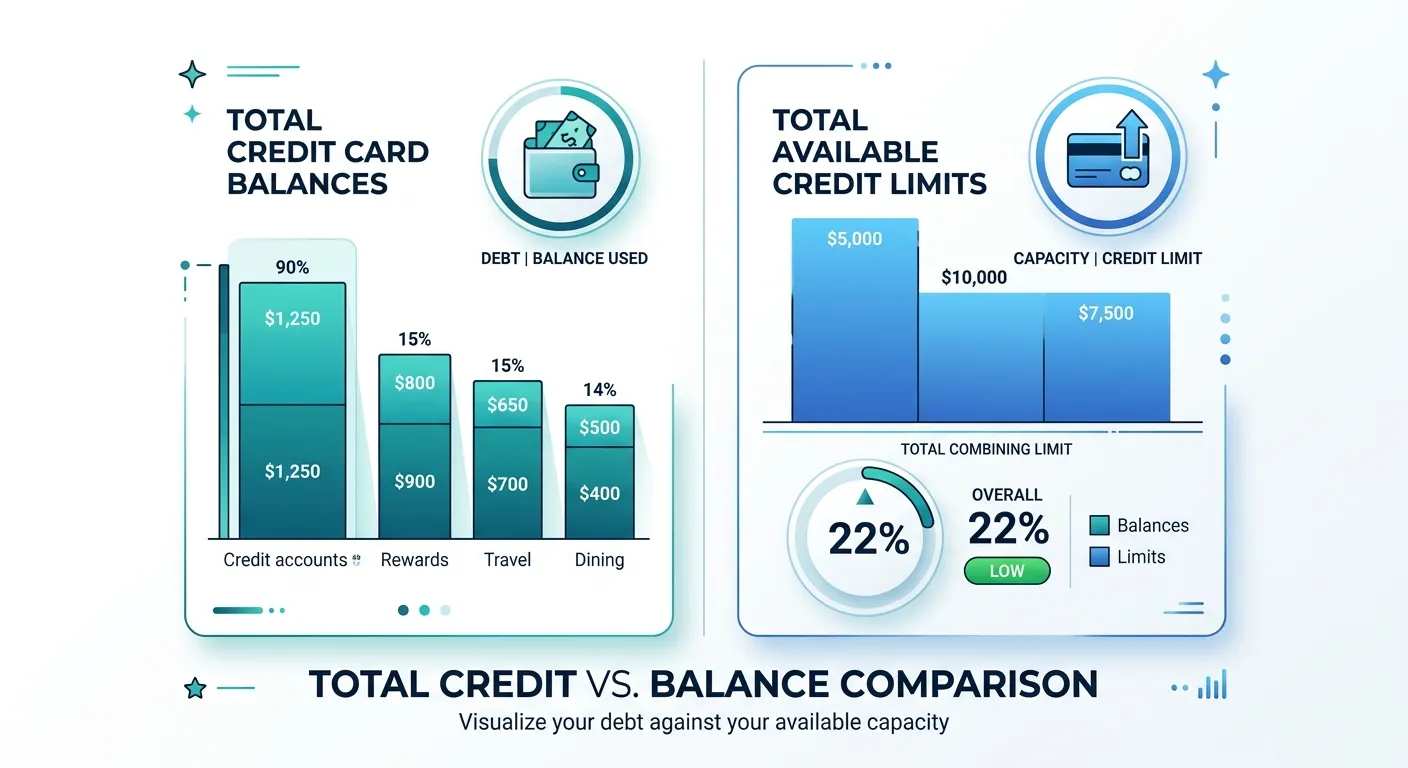
If Sarah closes Card B because she never uses or touches it, her total available limit drops to $2,500. Now her utilization jumps from 10% to 20% overnight! Keep older, zero-balance cards open and active by putting a tiny recurring charge (like a $5 subscription) on auto-pay.
4. Spread Your Balances Across Multiple Cards
Credit scoring algorithms calculate utilization in two ways:
- Overall Utilization: The total card balance divided by your total credit limit across all cards.
- Per-Card Utilization: Your single card balance divided by its respective credit limit.
Maxing out a single card can be even more detrimental to your score!
If you have a $1,000 balance on a card with a $1,000 credit limit (100% per-card utilization) and another card that has a $9,000 limit and a $0 balance, shift your everyday spending around so neither individual card reaches a high limit threshold.
5. Become an Authorized User
If you really struggle with low credit limits, ask a trusted relative (like a parent or spouse) with a high credit limit and great payment habits to add you as an authorized user on their credit card.
You don't need to hold or use the physical card! Once you are added to their account, that card's history—including its high available limit and low balance—will show up on your credit report.
If that relative has a card with a $10,000 limit and a tiny $200 balance, you automatically gain a much larger segment of available credit, which in turn drastically decreases your overall utilization percentage!
 Finnly Joy

Frequently Asked Questions (FAQ)
How fast will my credit score improve once I lower utilization?
Your credit score updates as soon as your card company updates its numbers with the credit bureaus. This is usually done once a month on your statement closing date. You will see positive jumps in your score within 30 to 45 days.
Is 0% credit utilization better compared to a 1% balance?
A slightly active utilization rate (between 1% and 3%) looks slightly better than 0% to creditors. Showing a tiny balance proves you actively use your credit responsibly rather than letting it sit completely dormant.
Will requesting a credit limit increase hurt my credit score?
It depends on the bank. If they perform a "soft pull" or "soft inquiry," it will not impact your score at all. However, if they perform a "hard pull," your score might temporarily drop by 2 to 5 points.
Final Thoughts: Take Control of Your Score Today
Knowing how to lower credit card utilization rate without paying money is all about understanding banks and their reporting timelines! Anyone can achieve a strong credit score no matter their income level by simply making smart, strategic adjustments. Check your statement closing dates today and take control of your credit journey!
Stay happy and wealthy,
Finlly Joy
 Finnly Joy

Disclaimer: The information provided in this article is for educational and informational purposes only and should not be construed as professional financial, investment, or legal advice. Financial situations and credit scoring algorithms vary by individual and location. Always consult with a certified financial advisor or credit professional before making any major financial decisions.